
When a turbocharger fails, the usual first move is to search for a replacement by the vehicle: production year, model, engine. Sometimes that works. Sometimes the turbo that arrives is wrong — same engine family, different unit — and the job stops while the part goes back. There is a more reliable way to order: identify the turbocharger itself. Every turbo carries its own identity on a nameplate, and the part number and OEM number stamped on it point to one exact unit, not a range of possibilities.
Why Year, Make and Model Are Not Enough
A vehicle listing is a starting point, not an identification. One engine application can correspond to a dozen or more turbo part numbers over its production run. The vehicle maker may fit turbos from two different suppliers in the same model year, change the specification mid-year, or update the installation without changing the model name. On top of that, the OEM part number itself is not stable: vehicle and engine manufacturers regularly supersede their own numbers, so the number in an old catalog may no longer match anything current.
There is a second problem in the workshop: the turbo on the engine is not always the turbo the catalog says should be there. A previous owner or an earlier repair may have fitted a different unit. If you order by vehicle information alone, you order for a turbo that may not even be on the car. The nameplate on the turbo that is actually fitted settles the question.
Where to Find the Nameplate
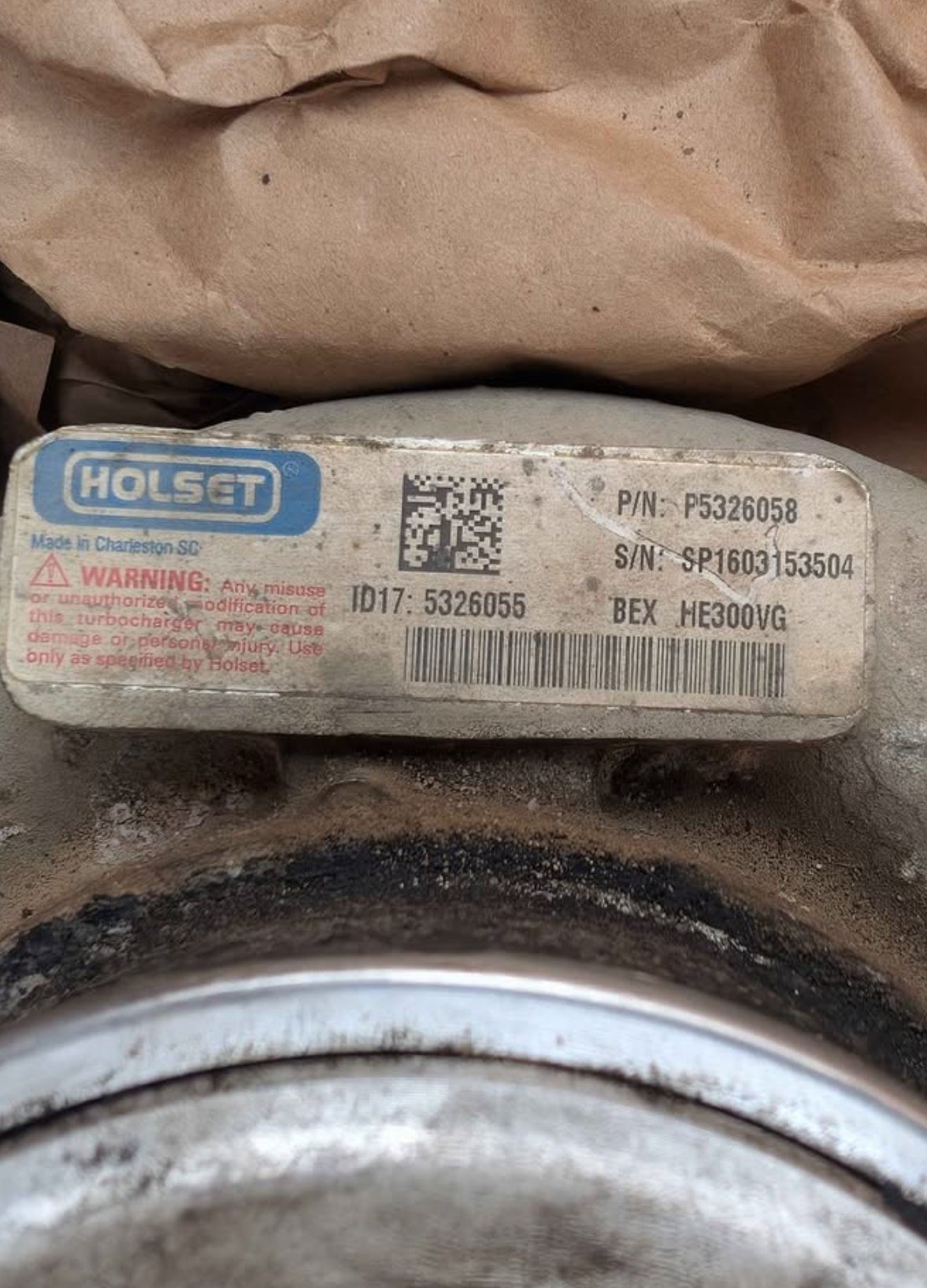
On most turbochargers the identification plate sits on the compressor housing — the aluminum “cold side” housing. Depending on the manufacturer it is a thin metal plate bonded or riveted to the housing, or the data is stamped or etched into a flat, machined pad on the housing itself. Less often, the plate is on the center (bearing) housing, and on some BorgWarner/KKK units it hides low on the housing near the oil feed and drain connections.
Not every turbo has a separate plate at all. Some manufacturers engrave the identity directly into the compressor housing — laser-engraved, or cast into the housing when it is produced. If you cannot see a plate, clean the compressor housing first. Years of oil film and road dirt cover the markings, and a plate that looks blank usually is not.
What the Numbers on the Nameplate Mean
Plates differ between manufacturers, but most carry the same four pieces of information:
| Field | What it is | Used for matching? |
|---|---|---|
| Part number | The turbo manufacturer’s own number for the complete unit (Garrett, BorgWarner, Holset, MHI, IHI) | Yes — the most reliable identifier |
| OEM number | The number the vehicle or engine manufacturer assigned to the same turbo (also called the customer part number) | Yes — works in most catalogs, but beware of superseded numbers |
| Turbo model | The frame family and type, such as GT1749V, K03, TD04, HX35 or RHF5 | No — it names the family, not the exact specification |
| Serial number | A code unique to that single turbo, tied to its production date and batch | No — it identifies the individual unit, not the replacement part |
The distinction that matters most is model versus part number. A model name like K03 or TD04 covers many different specifications — different wheels, housings and actuators — fitted to different engines. Two turbos can share a model name and still not interchange. The part number is what separates them. Newer plates from some manufacturers also carry a QR code next to the stamped fields; the stamped numbers are still the ones to quote when you order.
Part Number Formats by Manufacturer
Each manufacturer formats its part number differently. Recognizing the pattern tells you whose number you are looking at:
- Garrett: six digits, a dash, then four digits, sometimes with a suffix letter — for example 750216-5024S. Garrett part numbers start with 4, 7 or 8. Quote the number exactly as stamped, including the suffix.
- BorgWarner / KKK: eleven digits in three groups, such as 5303 970 0053. The first group is the frame (5303 = K03 family), and the middle group tells the supply channel: 970 is the number as originally fitted, 988 is the genuine replacement number for the same unit. When you search, try both — 970 and 988 versions of the number refer to the same turbo.
- Holset: a seven-digit assembly number, such as 3533544 or 4035330. On a Holset the assembly number is the part number to search. The plate also shows the model (HX, HE series) and the engine maker’s customer number.
- Mitsubishi (MHI): five digits, a dash, five digits, usually starting with 49 — for example 49131-05212. On many MHI units the number is engraved into the flat machined face of the compressor housing rather than carried on a plate.
- IHI: a short specification code of letters and digits — VF50, RHF5 and similar — stamped or engraved on a rectangular pad on the compressor cover. The full plate also carries the OEM number and serial number, which complete the identification.
Toyota-built turbos are the awkward exception: some carry no proper ID plate at all. There the usable identifier is the vehicle maker’s number in the 17201-xxxxx pattern, supported by a casting number on the turbine housing near the manifold flange.
If the Nameplate Is Missing or Unreadable
Start by cleaning the compressor housing properly — most “missing” plates are dirty ones. If the plate really is gone, check the housing itself for engraved or cast characters on any flat pad, and check the turbine housing for casting numbers. Take clear photos of every marking you find, from several angles; a number that is half-legible in person often reads clearly in a photo. The vehicle VIN is the last resort: it narrows the application down, but it still cannot confirm which turbo is fitted today, so treat a VIN match as a lead to verify, not a final answer.
Found the Number? Here Is the Next Step
Search the part number — or the OEM number — on our product pages. Turbocharger part numbers are exact: if the number matches a listing, that is the unit, the CHRA or the kit built for the turbo on your engine. If the turbo has already failed and you are deciding between repair and replacement, our turbocharger failure diagnosis guide walks through the inspection, and many units can be rebuilt with a rebuild kit matched by the same part number.
And if the number is not listed, or the plate will not read, send us a clear photo of the nameplate through the contact page. A photo of the plate — or of the numbers you can find on the housing — is enough for us to identify the turbo and confirm the correct replacement, core or kit before you order. It takes a minute, and it is the difference between ordering once and ordering twice.